Transparent LED film is usually introduced with short explanations and visuals, but those descriptions rarely capture how the technology truly behaves once it becomes part of a real space. When LED film is used on glass in commercial environments, its value goes far beyond visibility or motion. The most important details often emerge only after installation, during everyday use, and through long-term interaction with the space.
Understanding these less-discussed aspects helps decision-makers see LED film not as a novelty, but as a mature and practical solution for modern buildings.
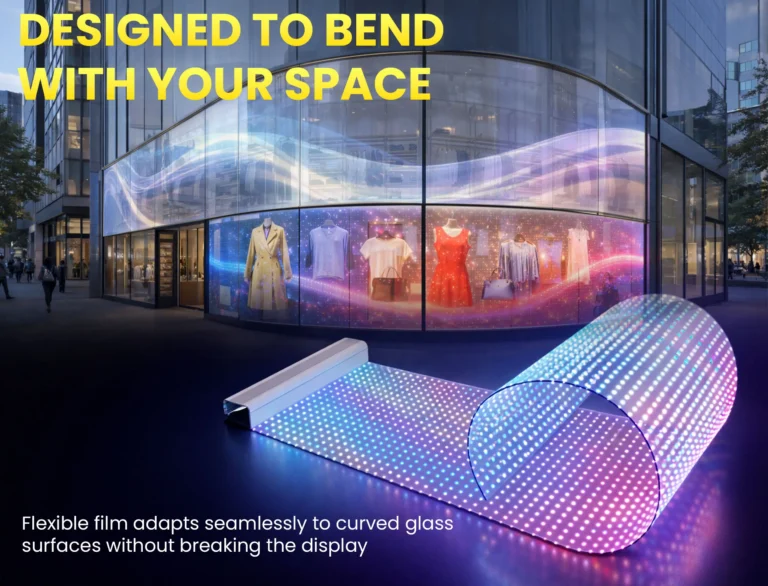
One of the most significant qualities of LED film is how quietly it integrates into architecture. Traditional digital displays often introduce visual weight. They sit on top of walls, windows, or facades and immediately announce themselves as technology. LED film behaves differently because it does not interrupt the original material. The glass remains visually dominant, and the digital layer becomes secondary.
This changes how designers and architects approach digital elements in a project. Instead of planning around a screen, they can treat LED film as an extension of the glass itself. Lines stay clean, views remain open, and the original architectural intent is preserved. For buildings where design consistency is critical, this integration becomes one of the strongest arguments for LED film.
Over time, this architectural harmony also helps the installation age better. Spaces continue to feel modern and intentional rather than overtaken by hardware.
Content displayed on transparent LED film feels fundamentally different from content shown on conventional screens. Because the background is not a solid surface, visuals interact with the environment behind the glass. Movement, depth, and light all play a role in how the message is perceived.
This transparency softens the digital experience. Messages feel less aggressive and more refined, even when the content itself is dynamic. For retail environments, this means promotions can attract attention without overwhelming passersby. For corporate spaces, it allows communication to exist without disrupting the atmosphere.
The result is a display that communicates while respecting the space, which is a key reason LED film is often selected for premium locations.
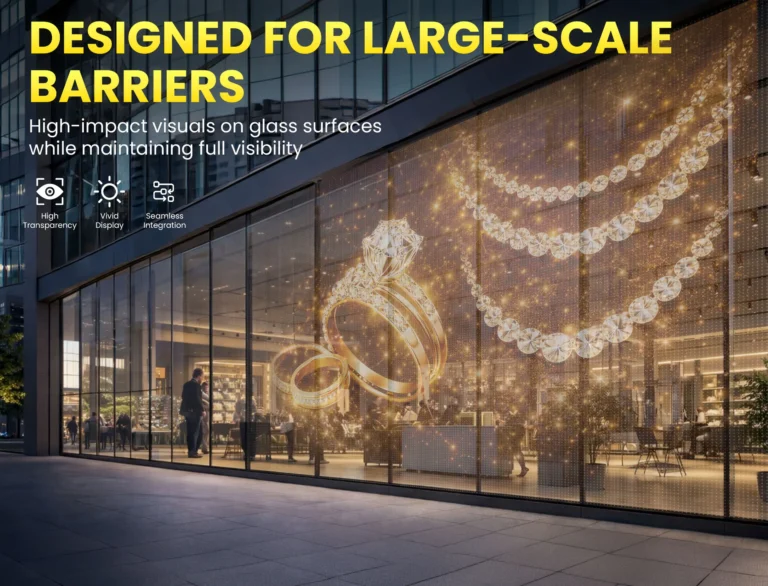
Glass is primarily valued for what it lets in: daylight. One of the most practical advantages of LED film is that it does not sacrifice this function. Even with active content, natural light continues to flow into the interior, maintaining brightness and openness.
During daytime hours, LED film works in harmony with ambient light rather than fighting against it. Interiors remain comfortable, and the space does not feel closed off. As daylight fades, the visual presence of the content increases naturally, without requiring physical changes or adjustments to the glass.
This day-to-night transition feels organic and keeps spaces visually balanced at all times, which is difficult to achieve with traditional display technologies.
LED film is often praised for its physical flexibility, but its operational flexibility is just as important. Once installed, the glass itself does not need to change. The digital layer can evolve continuously through content updates, scheduling, and programming.
Businesses can adapt messaging to seasons, events, or branding updates without revisiting the physical design of the space. This reduces long-term disruption and allows spaces to stay relevant without repeated renovations or replacements.
Over the lifespan of a building, this adaptability becomes a strategic advantage, turning LED film into a long-term communication platform rather than a fixed display.
Branding is not static, and LED film supports that reality. Instead of committing to permanent physical graphics, brands can use LED film to evolve their visual language over time while keeping the same architectural framework.
This consistency at the physical level combined with flexibility at the digital level creates a strong balance. Spaces feel stable, while messaging stays fresh. For commercial real estate, retail chains, and corporate environments, this approach supports long-term brand growth without visual fatigue.
LED film becomes part of the brand environment rather than a temporary marketing element.
At VRsmart Glass, LED film is considered a functional layer within a broader smart glass strategy. The focus is not solely on brightness or resolution, but on how the technology interacts with real spaces, real light conditions, and real users.
Each project is approached with attention to transparency, clarity, and integration. The goal is to make the technology feel natural rather than noticeable. When LED film is implemented correctly, people focus on the space and the message, not on the display itself.
This perspective ensures that LED film enhances environments without redefining them.
Ultimately, LED film changes how glass is used. Instead of serving only as a boundary or window, glass becomes an active participant in communication. It can inform, attract, and adapt while remaining visually light and architecturally honest.
This shift does not require dramatic changes to buildings. It simply adds intelligence and flexibility to an existing material. When used thoughtfully, LED film transforms glass into a dynamic asset that supports both design and function in a modern, understated way.