In the modern restaurant landscape, success is no longer driven solely by food quality or location. While these elements remain essential, they are no longer enough on their own to guarantee consistent customer flow.
Today, attention is the most valuable currency.
Restaurants are not just competing with each other — they are competing with every visual stimulus on the street. From digital billboards to storefront displays, customers are constantly exposed to content that fights for their attention.
In this environment, static glass windows are a missed opportunity.
LED film technology changes that completely.
Most restaurants, cafés, and food chains have one thing in common: large glass surfaces facing the street.
Traditionally, these surfaces serve a passive role:
However, from a business perspective, this is highly inefficient.
These glass surfaces sit in some of the most valuable real estate a restaurant owns — directly facing potential customers — yet they generate no measurable return.
LED film transforms this passive surface into an active, high-impact communication channel.
Instead of being “just glass,” it becomes a dynamic digital layer that works continuously to attract, inform, and convert.
Unlike traditional LED screens, LED film is:
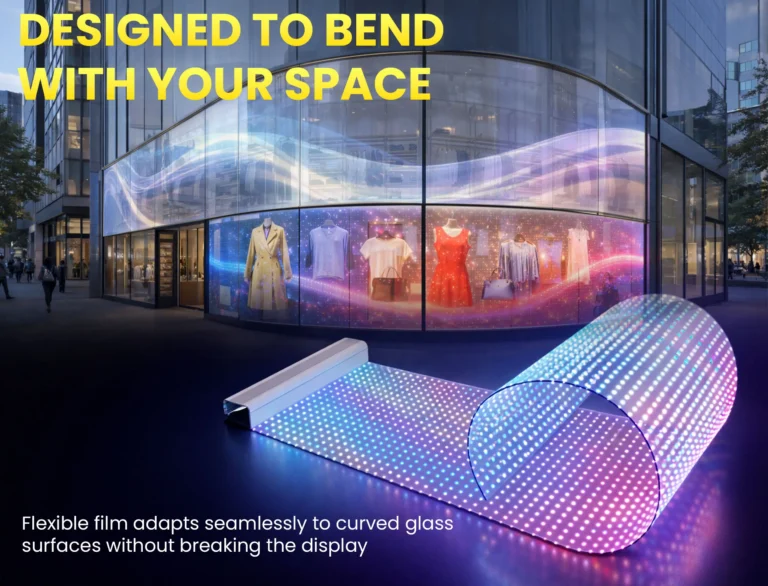
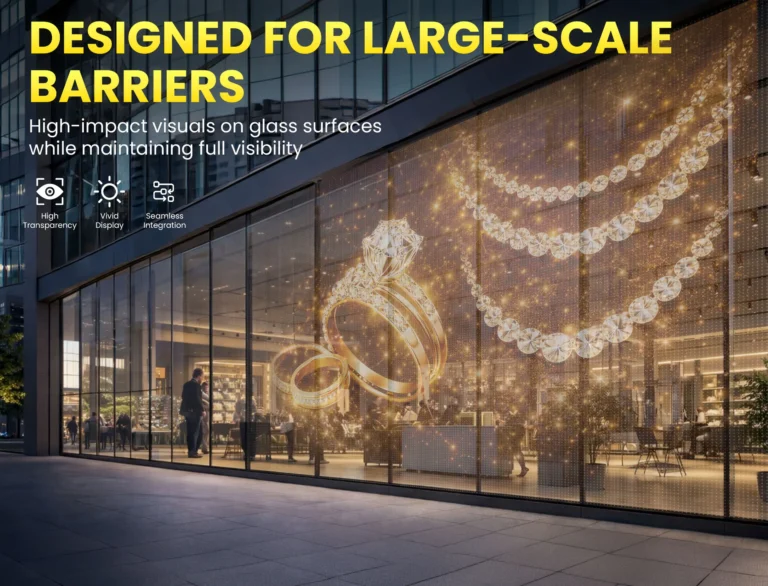
This means restaurants can upgrade their storefront without blocking natural light or altering the design of the space.
More importantly, they gain a powerful digital surface without sacrificing aesthetics.
To understand the true value of LED film, it’s important to break down how it impacts revenue at a practical level.
1. Capturing Attention in a Crowded Environment
Human attention is naturally drawn to movement and light.
Static signage, no matter how well designed, fades into the background over time. LED film, on the other hand, introduces motion, brightness, and contrast — all of which are proven to increase visibility.
For a passerby walking down the street, this difference is critical.
A dynamic visual of a freshly prepared dish or a limited-time offer can create a moment of pause — and that pause is the first step toward conversion.
2. Converting Attention into Foot Traffic
Attracting attention is only the first step. The real value comes from turning that attention into action.
LED film enables restaurants to communicate clearly and instantly:
This kind of real-time messaging reduces decision friction.
Instead of wondering what the restaurant offers, potential customers receive immediate, visually engaging information — making it easier to step inside.
3. Increasing Average Order Value
Once customers are inside, purchasing decisions are still influenced by what they have seen.
LED film allows restaurants to strategically promote:
By visually priming customers before they even enter, restaurants can subtly guide ordering behavior.
This leads to higher ticket sizes without requiring additional sales effort from staff.
4. Extending Marketing Beyond Daylight Hours
Traditional signage loses effectiveness after sunset.
LED film, with brightness levels reaching up to 4500 nits, remains highly visible both during the day and at night.
This means your storefront continues to:
…even when surrounding businesses fade into the background.
In effect, your restaurant gains a 24/7 marketing presence.
A Real-World Scenario
Consider a mid-sized restaurant located on a busy urban street.
Before LED Film:
After LED Film Installation:
Within weeks, noticeable changes occur:
The key takeaway is simple:
Nothing about the location changed — only how the space communicates.
LED film is not just a display tool — it taps directly into consumer behavior.
In food environments:
A well-timed visual of a dish can trigger craving almost instantly.
This is why digital menu boards and food photography are so effective — and LED film brings that same effect directly to the street.
Beyond immediate revenue impact, LED film also contributes to how a restaurant is perceived.
A storefront enhanced with digital visuals communicates:
For brands looking to differentiate themselves — especially in competitive markets — this perception can be just as valuable as direct sales.
Customers are more likely to associate the brand with quality, experience, and professionalism.
Unlike temporary marketing campaigns, LED film is an infrastructure investment.
Once installed, it becomes a permanent communication platform that can be updated at any time:
This flexibility allows restaurants to stay relevant without recurring production costs.
Restaurants already invest heavily in:
LED film simply unlocks the full potential of something they already have — their glass.
Instead of being passive, that glass becomes:
And in a competitive environment where attention defines success, this transformation can make a measurable difference.
If you’re looking to increase visibility, attract more customers, and create a stronger presence without changing your location, LED film offers a highly effective solution.
Reach out to explore real-world applications and discover how it can be adapted to your space.