When businesses first explore LED film technology, one of the most common questions is about maintenance. Because LED film is applied directly to glass and looks highly technical, it is often assumed that upkeep must be complex or demanding. In reality, LED film maintenance is far more straightforward than many people expect, especially when the system is properly planned and installed.
Understanding how LED film behaves over time helps set realistic expectations and highlights why it is increasingly chosen for long-term commercial use.
One of the main reasons LED film is easier to maintain than expected is its minimal physical structure. Traditional LED screens rely on cabinets, frames, ventilation systems, and external mounting hardware. Each of these elements adds complexity and increases maintenance needs.
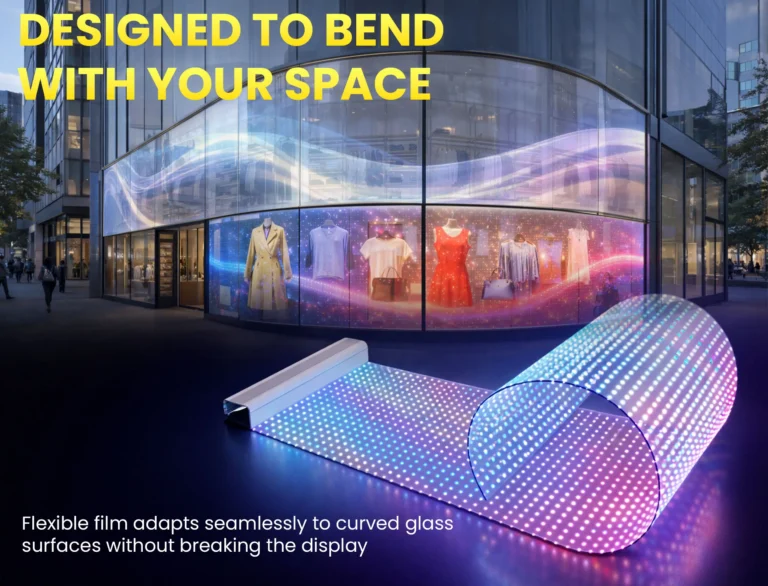
LED film, by contrast, is integrated directly onto the glass surface. There are no bulky housings or moving parts. This simplified structure reduces the number of components that can wear out or require frequent attention. As a result, routine maintenance focuses more on system monitoring than on physical intervention.
Because LED film becomes part of the glass, cleaning routines remain largely unchanged. Standard glass-cleaning practices are typically sufficient, and no specialized tools are required. The film is designed to maintain transparency and clarity even with regular use.
This is particularly important for storefronts, offices, and commercial buildings where glass is already part of daily maintenance schedules. LED film does not introduce an entirely new cleaning process, which makes it easier to integrate into existing facility management routines.
Another aspect that simplifies maintenance is content management. LED film systems are controlled digitally, allowing updates, adjustments, and scheduling to be handled remotely. Brightness levels, display timing, and visual content can all be managed without physical access to the glass.
This means that many “maintenance” tasks are actually software-based rather than hardware-based. Updates can be made quickly, and performance can be monitored without disrupting the space or the people using it.
LED film is engineered to operate consistently over extended periods. When installed correctly, it remains stable and reliable under normal commercial conditions. Because it is protected by the glass surface itself, the film is less exposed to accidental impact compared to external screens.
This built-in protection contributes to long-term reliability and reduces the need for frequent repairs. Over time, this durability translates into predictable performance rather than ongoing maintenance demands.
A well-planned LED film installation emphasizes preventive care rather than reactive fixes. Routine system checks, occasional calibration, and content optimization help ensure consistent performance. These actions are typically scheduled and do not require emergency responses.
This proactive approach allows businesses to maintain visual quality without unexpected downtime. Instead of reacting to problems, teams can focus on optimizing how the display supports their communication goals.
This built-in protection contributes to long-term reliability and reduces the need for frequent repairs. Over time, this durability translates into predictable performance rather than ongoing maintenance demands.
While LED film itself is designed for ease of maintenance, the quality of the initial installation plays a key role. Proper alignment, clean application, and correct system configuration all contribute to long-term stability.
When installation is handled professionally, maintenance remains simple and predictable. This is why experienced providers approach LED film as a complete system rather than just a product.
At VRsmart Glass, maintenance is considered part of the overall project lifecycle, not an afterthought. LED film solutions are designed with accessibility, reliability, and long-term usability in mind.
By focusing on high-quality materials, precise installation, and smart system design, VRsmart Glass ensures that LED film remains easy to manage over time. The goal is to provide a solution that performs consistently without adding operational complexity.
So, is LED film hard to maintain? In practice, it is not. When compared to traditional digital display systems, LED film often requires less physical intervention and fits naturally into existing maintenance workflows.
With the right planning and expertise, LED film becomes a low-maintenance, high-impact solution that supports long-term visual communication without creating additional burden for businesses or facility managers.