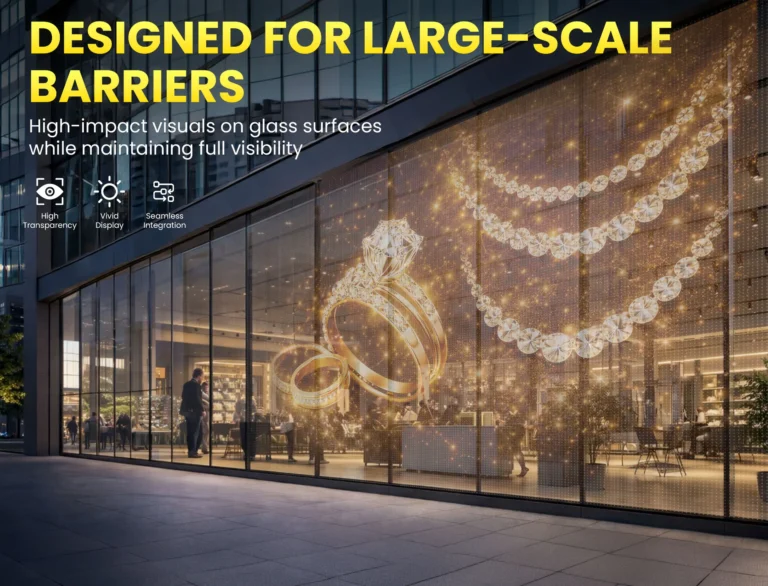
For decades, glass has played a passive role in architecture. It allowed light to enter, created openness, and stayed visually neutral. It was never meant to communicate. LED Film fundamentally changes this role by turning glass into an active visual surface—without stripping it of its transparency or architectural purpose.
This shift matters because communication has moved beyond screens. In modern environments, people are oversaturated with displays competing for attention. What stands out today is not what is louder, but what is unexpected. LED Film works precisely because it appears where communication traditionally does not exist: within glass itself.
Rather than adding another digital layer onto a space, LED Film allows the space to speak.
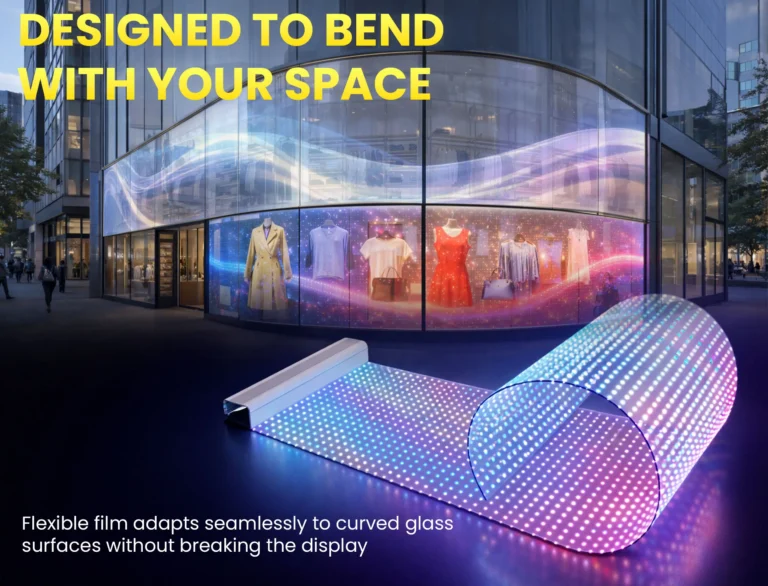
Traditional digital displays sit on top of architecture. They are attached, mounted, framed, and visually separated from the building itself. LED Film removes this separation. The content exists within the glass, not in front of it, allowing architecture and message to operate as a single system.
This integration changes how people perceive both the building and the message. The communication no longer feels imposed. It feels intentional. Whether used on a storefront façade, a showroom window, or an interior glass partition, LED Film allows messaging to emerge naturally from the space rather than interrupt it.
Because the glass remains transparent when content is inactive, the building never feels permanently occupied by media. This balance between visibility and restraint is what makes LED Film suitable for high-end retail, premium commercial spaces, and architecturally refined environments.
One of the most significant challenges in visual communication today is fatigue. People are constantly exposed to static signage, oversized screens, and aggressive brightness. LED Film takes a different approach by leveraging movement, contrast, and placement rather than sheer intensity.
Motion within glass triggers curiosity. It causes people to pause because it breaks expectation. Windows are not supposed to move. When they do, attention follows naturally. This effect is particularly powerful in retail environments, where foot traffic decisions are made in seconds.
Instead of shouting for attention, LED Film invites it. This distinction leads to longer viewing times, stronger recall, and a more positive emotional response to the message being delivered.
LED Film is often described as a display technology, but its real value lies in how it shapes experience. A storefront using LED Film is no longer just advertising—it becomes dynamic, responsive, and alive. Messaging can change throughout the day, adapting to time, audience, or campaign goals without any physical alteration.
Inside commercial spaces, LED Film allows glass partitions to serve dual roles. They can remain visually open while inactive, then transform into communication surfaces when needed. This flexibility enables designers and brands to rethink how information, branding, and atmosphere coexist within the same environment.
In public-facing buildings, LED Film can be used to communicate information, guide movement, or enhance architectural identity without relying on traditional signage systems that clutter space.
One of the most practical advantages of LED Film is what it does not require. There is no need for heavy frames, additional mounting structures, or permanent hardware installations. The glass remains the structure. The content simply inhabits it.
This gives architects and designers freedom. They can introduce digital communication without redesigning façades or interiors. Sightlines remain clear. Natural light continues to flow. The architectural language stays intact.
Because LED Film does not dominate the space when inactive, it supports long-term design consistency rather than locking a building into a specific visual identity.
LED Film is not tied to a single campaign, message, or use case. Its value grows over time because content can evolve without physical change. Brands can refresh messaging instantly. Seasonal campaigns can be launched and removed without replacing materials. Spaces can shift purpose without redesign.
This adaptability reduces long-term costs associated with printed signage, screen upgrades, and repeated installations. More importantly, it allows spaces to remain current in a fast-changing visual culture.
LED Film becomes less of a display choice and more of a communication infrastructure embedded into the building itself.
LED Film changes the fundamental role of glass. It allows buildings to communicate, storefronts to engage, and spaces to respond—without sacrificing transparency, light, or architectural integrity.
When glass stops being background and becomes the message, communication no longer feels added on. It becomes part of the environment people move through, notice, and remember.
That is where LED Film delivers its real impact—not as a screen, but as a new way for architecture to speak.