In today’s cities, advertising is everywhere. Billboards dominate highways, digital screens illuminate shopping districts, and LED displays compete for attention in busy urban environments. Yet as cities become more visually crowded, traditional advertising methods are gradually losing their impact. Consumers are increasingly desensitized to conventional advertisements, forcing brands to search for more subtle, innovative ways to communicate with audiences.
One of the most fascinating developments in modern advertising technology is transparent LED film. Unlike traditional displays, transparent LED film allows digital content to appear directly on glass surfaces without blocking visibility. Storefront windows, building facades, and architectural glass panels can instantly transform into dynamic media surfaces while remaining visually open and elegant.
This innovation has introduced a new concept in marketing: invisible advertising. Instead of overwhelming the environment with large, opaque screens, brands can now integrate digital messaging seamlessly into architecture itself. Transparent LED film is rapidly redefining how companies communicate in urban spaces, creating advertisements that are visually engaging yet naturally integrated into the city landscape.
Modern cities are saturated with visual media. Large billboards, LED panels, posters, and signage compete for attention in every direction. While these methods once revolutionized advertising, their effectiveness has gradually declined due to visual overload.
Urban consumers are exposed to thousands of advertising messages every day. As a result, people have developed a natural tendency to ignore conventional displays. This phenomenon, often referred to as advertising fatigue, has forced brands to rethink how they interact with audiences.
Traditional digital displays also present several practical challenges:
Because of these limitations, architects, designers, and marketers have begun exploring technologies that combine digital communication with architectural harmony.
Transparent LED film is a lightweight, ultra-thin display technology designed to be applied directly to glass surfaces. Unlike traditional LED panels that require rigid structures, LED film consists of flexible layers embedded with microscopic LED circuits.
Once installed on glass, the film remains highly transparent. From a distance, the surface appears like ordinary glass. However, when activated, the embedded LEDs illuminate to display dynamic visual content such as:
Because the technology preserves visibility through the glass, it maintains the openness of architectural spaces while adding digital functionality.
In other words, transparent LED film transforms ordinary windows into interactive media surfaces without fundamentally altering the building design.
The term invisible advertising describes marketing that integrates naturally into everyday environments without appearing intrusive. Instead of forcing consumers to look at advertisements, this approach allows advertising to blend seamlessly into the visual experience of a space.
Transparent LED film perfectly embodies this concept.
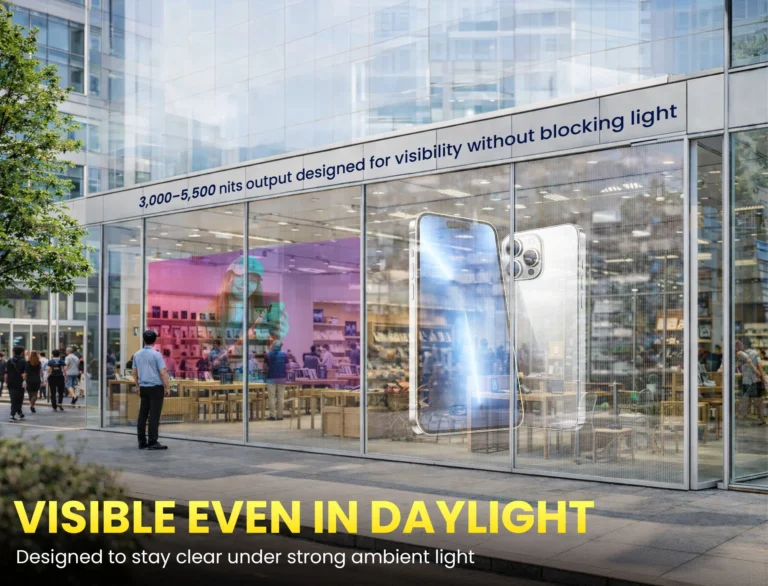
During the daytime, storefront windows maintain their natural transparency, allowing customers to see inside the store while digital content appears softly integrated with the glass. At night, these same surfaces can transform into vibrant digital displays visible across the street.
This dual functionality creates a unique marketing advantage: advertisements become part of the architecture rather than separate from it.
As a result, transparent LED film offers brands a subtle yet powerful way to communicate messages without overwhelming the viewer.
Retail storefronts have always been one of the most important spaces for attracting customers. Traditionally, businesses rely on physical window displays, posters, or static signage to capture attention.
Transparent LED film takes storefront marketing to an entirely new level.
Instead of static displays, brands can present dynamic digital content directly on their windows, including:
The key advantage is that these displays do not block visibility into the store interior. Customers can simultaneously see both the products inside and the digital messaging on the glass.
This creates a layered visual experience that significantly increases engagement and curiosity among passersby.
Many luxury brands, fashion retailers, and technology companies have already begun adopting this technology to create high-impact storefront experiences.
Beyond retail applications, transparent LED film is also transforming building architecture itself.
In modern cities, glass is one of the most widely used architectural materials. Skyscrapers, office buildings, shopping malls, and airports often feature expansive glass facades.
Transparent LED film allows these surfaces to function as massive digital communication platforms without compromising the architectural design.
Buildings equipped with LED film can display:
At night, entire glass facades can transform into dynamic digital canvases visible across city skylines.
This phenomenon is part of a growing movement known as media architecture, where buildings become interactive visual elements within the urban environment.
Transparent LED film offers several strategic advantages for modern advertising.
Architectural Integration
Unlike bulky LED screens, LED film integrates seamlessly with glass structures. This allows advertisers to utilize surfaces that were previously unused for digital communication.
High Visibility Without Obstruction
The transparency of the film ensures that natural light and interior visibility remain intact, making it ideal for retail spaces and office environments.
Flexible Installation
Because LED film is lightweight and flexible, it can be installed on existing glass without major structural modifications.
Modern Aesthetic Appeal
The technology supports a clean, futuristic aesthetic that aligns with contemporary architectural trends.
Dynamic Content Control
Businesses can update digital content remotely, allowing marketing campaigns to change instantly without replacing physical materials.
As cities continue evolving into smart, technology-driven environments, advertising methods will inevitably change alongside them.
Consumers increasingly expect experiences that feel integrated, immersive, and visually sophisticated. Traditional billboards and static signage may gradually give way to smarter systems that merge communication with architecture.
Transparent LED film represents one of the most promising technologies leading this transformation.
By turning ordinary glass into digital media surfaces, brands gain access to vast new spaces for storytelling, marketing, and creative expression.
In the coming years, we may see entire city districts where glass buildings, storefronts, and transportation hubs function as dynamic communication platforms.
Advertising will no longer exist only on separate structures — it will become part of the urban fabric itself.
Transparent LED film is redefining the relationship between architecture, technology, and marketing. By enabling digital content to appear directly on glass without obstructing visibility, this technology introduces a new form of subtle yet powerful communication.
Through the concept of invisible advertising, brands can deliver engaging messages that feel naturally embedded in the city environment rather than imposed upon it.
As urban spaces grow increasingly sophisticated, transparent LED film is poised to play a crucial role in shaping the future of digital advertising — transforming everyday glass surfaces into intelligent, dynamic media platforms.