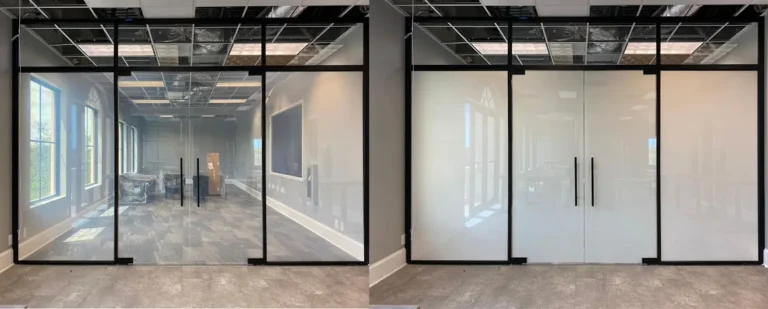
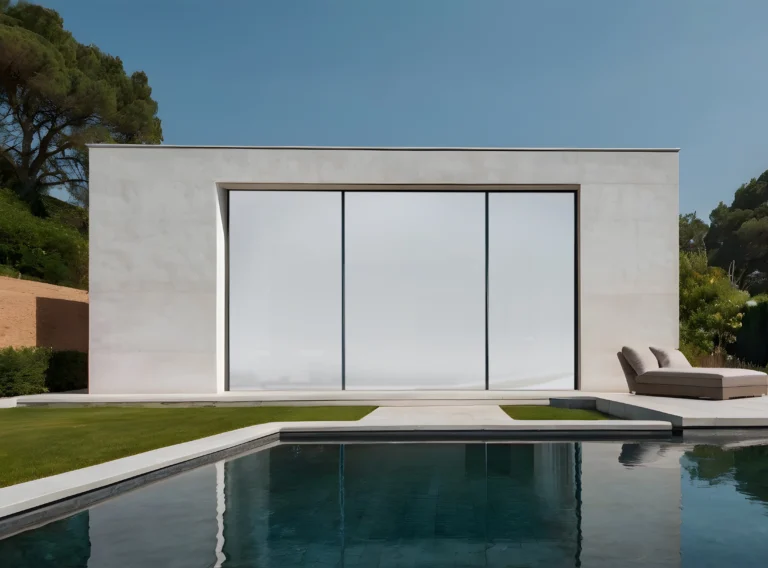
Glass has become one of the most dominant materials in modern architecture. It represents openness, transparency, and contemporary design. However, as glass increasingly defines offices, commercial buildings, healthcare facilities, and luxury residences, an important reality emerges: not every space is meant to be visible.
Black Smart Film was developed to address this exact need. It is not a decorative add-on or a secondary privacy solution. It is a purpose-built technology for environments where visual control, discretion, and authority are essential. Rather than compromising design with curtains or mechanical systems, Black Smart Film integrates privacy directly into the glass itself.
Unlike standard Smart Film, which primarily diffuses light to reduce visibility, Black Smart Film is engineered to deliver a much stronger opaque state. When the film is switched off, it significantly limits light transmission and prevents silhouettes, shadows, or movement from being seen through the glass. This creates a deep, confident visual barrier that standard translucent solutions cannot achieve.
This difference is critical in professional environments where even partial visibility can create discomfort or risk. Black Smart Film does not offer “reduced visibility.” It offers certainty. When privacy is activated, the space is visually sealed, allowing occupants to operate without concern about being observed from the outside.
Black Smart Film is based on PDLC technology, applied directly to glass surfaces. When electrical current is applied, the liquid crystal molecules align, allowing light to pass through and making the glass transparent. When the power is turned off, the molecules scatter and absorb light, shifting the glass into a dark opaque state.
What distinguishes Black Smart Film is how this opaque state performs under real lighting conditions. Even in brightly lit interiors or daylight-exposed façades, the film maintains its privacy effect. This reliability makes it suitable for environments where lighting conditions change throughout the day but privacy expectations remain constant.
The transition between transparent and opaque states is instant and can be controlled via wall switches, remote controls, or integrated building automation systems.
Black Smart Film is intentionally designed for spaces where privacy directly impacts performance, trust, or experience. In executive offices and boardrooms, it allows confidential discussions to take place without visual exposure while preserving a modern glass-based design. In healthcare environments, it supports patient dignity and discretion without introducing heavy or unhygienic materials.
Financial institutions, legal offices, and security-sensitive facilities benefit from the film’s ability to block visibility completely when required. In luxury residential projects, Black Smart Film enhances exclusivity by allowing residents to control visibility without sacrificing architectural openness. Across these applications, the film functions as both a technical solution and a design asset.
Beyond its functional benefits, Black Smart Film contributes a distinct visual character to a space. In its opaque state, the dark surface introduces contrast, depth, and a sense of authority. Designers often use it intentionally to define zones within open layouts, replacing solid walls or layered window treatments.
Because the privacy function is embedded within the glass, the overall design remains clean and minimal. There are no additional elements competing for attention, and no compromises to the original architectural vision.
Black Smart Film offers long-term advantages over traditional privacy solutions. With no moving parts or mechanical systems, it requires minimal maintenance. There are no fabrics to clean, replace, or adjust, and no components that wear down over time due to repeated use.
This makes it a reliable choice for high-traffic commercial environments as well as premium residential spaces. Over time, it reduces operational costs while preserving both functionality and aesthetics.
Black Smart Film is not designed for situations where privacy is optional. It is chosen when privacy must be absolute, controlled, and intentional. It represents a shift in how architects, designers, and decision-makers approach glass—not as a material that must always reveal, but as one that can respond intelligently to its environment.
When transparency is no longer a default requirement, and control becomes the priority, privacy must be built into the design itself.
That is the power of Black Smart Film.